


Article 5 min read

Maximizing Roth Conversions Through Strategic Timing and Residency Planning

For high-net-worth individuals and retirees, Roth conversions represent one of the most powerful levers in tax-efficient retirement planning. At their core, Roth conversions allow taxpayers to control when they pay taxes – but when layered with thoughtful timing and geographic planning, they can significantly reshape long-term financial outcomes.

By coordinating income levels, future tax expectations and state residency, taxpayers can reduce lifetime taxes, increase after-tax portfolio value and create more efficient wealth transfer strategies. A truly optimized Roth conversion strategy is not just about when you convert – it’s also about where you convert. 

Understanding Roth Conversions

A Roth conversion is the transfer of funds from a traditional (pre-tax) retirement account to a Roth (after-tax) retirement account. Because deductible contributions to traditional IRAs are made with earnings that have not yet been taxed, the deferred tax must be paid at the time of conversion.

This creates a unique planning opportunity: a Roth conversion allows taxpayers to decide when to pay the tax. The most effective strategies typically involve converting assets during years when the taxpayer is in a relatively low tax bracket.

A common planning window occurs after retirement but before required minimum distributions (RMDs) and/or Social Security begin – periods when taxable income is often lower.

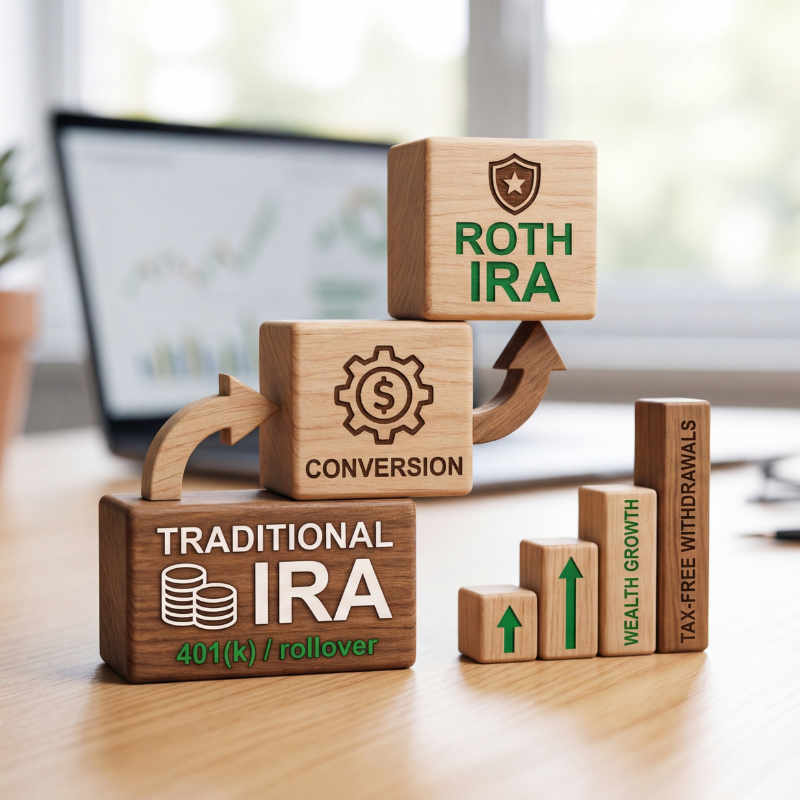
Roth IRA Conversion Concept with Wooden Blocks for Retirement Planning and Wealth Growth

Core Benefits of Roth Conversions

When executed thoughtfully, Roth conversions offer several long-term advantages:

  • Increase the after-tax value of your investment portfolio
  • Reduce future RMD exposure and help manage future tax brackets
  • Extend tax-free growth
  • Improve outcomes for heirs

Who Should Consider a Roth Conversion

Roth conversions are particularly effective for:

  • Taxpayers who expect to be in a higher tax bracket in the future
  • Individuals who will not fully rely on RMDs for living expenses
  • Households likely to face estate tax considerations
  • Taxpayers whose heirs may be in higher tax brackets
  • Individuals focused on maximizing after-tax wealth transfer

However, they may be less appropriate for taxpayers planning to leave significant IRA assets to charitable organizations.

Why Residency Matters in Roth Conversion Planning

While many strategies focus on timing conversions during lower-income years, the state in which a taxpayer is resident when a conversion is executed can materially affect the total tax cost.

Several states impose taxes on IRA distributions and Roth conversion income, while others do not.

The Florida Advantage in Roth Conversions

Florida does not impose a state personal income tax on the following:

  • Wages
  • Investment income
  • IRA distributions
  • Roth conversion income

As a result, Roth conversions completed while a Florida resident are typically subject only to the federal income tax, eliminating any additional state-level tax burden.

For individuals relocating from high-tax states, executing Roth conversions after establishing Florida residency can significantly reduce the total tax paid on converted amounts. This is especially impactful for retirees planning multi-year conversion strategies before required minimum distributions (RMDs) begin.

Enhancing the Long-Term Value of Roth Strategies

Because Florida does not tax IRA distributions, Roth IRA withdrawals or investment income and capital gains, a greater portion of the converted capital remains invested and compounding tax-free. 

This enhances the long-term effectiveness of Roth strategies, particularly for:

  • Early retirees
  • Households with large pre-tax balances
  • Individuals planning to rely heavily on Roth assets later in retirement

Florida also imposes no state estate or inheritance tax. When combined with Roth IRA assets – which must be distributed within ten years to non-spousal heirs but are generally tax-free at the federal and state level – this can substantially improve after-tax outcomes for beneficiaries, particularly those in higher tax brackets or high-tax states.

Asset Protection and Homestead Benefits (Planning-Adjacent Considerations)

Florida residency may also introduce non-income-tax advantages that support broader wealth planning:

  • A homestead exemption that reduces assessed property value for tax purposes. 
  • The Save Our Homes provision, which limits annual increases in assessed value. 
  • A set of strong statutory asset protection laws, including protections for retirement accounts and qualified homestead property. 

While these benefits are not directly related to Roth conversions, they often factor into coordinated retirement and estate planning decisions.

Important Caveat: Residency Must Be Substantively Established

States with income taxes may scrutinize claimed residency changes. To realize these benefits, a taxpayer must genuinely establish Florida domicile, typically evidenced by factors such as:

  • Primary residence location
  • Driver’s license and voter registration
  • Spending more time in the state than anywhere else
  • Location of near and dear possessions
  • Consistency across tax filings and legal documents

Failure to properly establish residency can result in continued taxation by the prior state.  The failure to properly plan a change of domicile is planning to fail an audit challenge by the legacy state tax authority. 

Bringing It All Together

Roth conversions are more than a tactical decision – they are a strategic opportunity to reshape long-term financial outcomes. When thoughtfully implemented, they can reduce lifetime tax burdens, extend tax-free growth and improve the efficiency of wealth transfer. 

Ultimately, maximizing Roth conversions requires coordination across income timing, tax regimes and overall financial planning to unlock their full value. 

Withum plus signs.

Have Questions or Need Guidance?

For more information on this topic, please contact a member of our Private Client Services Team.

Contact Us

Related Insights

Read more
red glowing caution symbol representing a scam
IRS CP53E Refund Notice Scams: What Taxpayers Should Know

Accounting firms are seeing a noticeable increase in scams tied to IRS Notice CP53E, a legitimate notice that the Internal Revenue Service (IRS) has been issuing more frequently this year. As the IRS continues moving away from paper refund checks and toward electronic payments, many taxpayers are encountering CP53E for the first time – creating…

Read more
a busy street in new york city.
What Mamdani’s Estate Tax Proposal Could Mean for New York Estate Planning

For many New Yorkers, estate tax planning has felt like something that could wait. Under current law, that reaction is understandable. New York’s basic exclusion amount for 2026 is $7.35 million, which means many families and business owners still feel comfortably outside the state estate tax conversation. That is why the recent proposal linked to…

Read more
A judge's gavel in a digital environment.
Galli v. Commissioner: Applicable Federal Rate (AFR) – A FMV Proxy?

Estate of Galli v. Comm’r, T.C., No. 7003‑20 and 7005‑20 involves an intra‑family loan that the Court determined was a valid, interest‑bearing obligation rather than a disguised gift, recognizing that a note issued at the Applicable Federal Rate (AFR) with proper documentation and timely interest payments can be respected as a bona fide loan while…