



Articles

When Quarterly Valuations Cannot Keep Pace: Managing AI Disruption Across the Private Equity Portfolio

Key Takeaways

AI disruption can move faster than the quarterly valuation cycle. For software and other AI-exposed businesses, customer behavior, competitive positioning and public-market multiples can change materially between measurement dates.

Strong operating performance does not eliminate valuation risk. A portfolio company can meet its EBITDA plan while still facing multiple compression if AI changes expectations around growth, pricing power or the durability of recurring revenue.

Fund managers need leading indicators, not only historical financials. Metrics such as net revenue retention, churn, customer acquisition efficiency, renewal pricing and AI-related competitive displacement can help identify changing valuation assumptions earlier.

Valuation monitoring should connect directly to ASC 820 governance. Emerging operating and market signals should inform comparable-company selection, forecast assumptions, scenario analysis, exit multiples and valuation committee documentation.

Overview

Recent pressure in private credit provides an important lesson for private equity managers: market signals can move materially faster than quarterly valuation processes. The issue may be particularly acute in software, where AI can alter competitive positioning, customer retention, pricing power and expected growth within a matter of months. Fund managers that establish a disciplined, forward-looking monitoring process before periods of market stress may be better positioned to identify changing valuation assumptions and respond to limited partner (LP) questions.

In early 2026, several large private credit funds received redemption requests representing 8% to 12% of NAV in a single quarter, stressing or exceeding 5% quarterly redemption limits. At the same time, public software equities repriced sharply amid concerns about AI competition and displacement, while reported private-market NAVs changed more slowly. Private-fund valuations are established through each manager’s valuation process, which may incorporate third-party valuation specialists, and are updated periodically rather than continuously. Secondary-market discounts can reflect liquidity, transaction structure and investor sentiment as well as views about underlying value; they do not, by themselves, establish that reported NAVs are misstated. However, widening differences between public-market signals, secondary pricing and private marks may warrant closer review of the assumptions supporting fair value.

For private equity managers, the central question is not simply whether the prior quarter’s valuation was supportable. It is whether emerging operating and market evidence indicates that assumptions supporting the valuation are changing before the next measurement date. The private credit experience is not directly comparable to closed-end PE funds, but it illustrates how quickly confidence can weaken when market signals and periodically reported values appear to diverge.

Enhanced disclosure alone may not close this gap. A forward-looking valuation discipline that connects portfolio-company operating indicators, market evidence and scenario analysis to the fund’s existing reporting and valuation process can help managers identify potential changes earlier.

For more on how AI is changing software business models and valuation assumptions, read How AI Is Resetting the SaaS Valuation Multiples in Private Equity and Private Credit.

The Bifurcation of Software Values

How Is AI Disruption Affecting Private Portfolio Values?

Although recent pressure surfaced first in private credit, AI-related disruption is not confined to lenders. Software represented 18% of PE deal value in 2025, and SaaS accounted for nearly 33% of venture funding. For PE and growth-equity holdings, the relevant issue is whether changes in public comparable-company multiples, customer behavior and expected growth indicate that prior valuation assumptions should be reassessed before those changes are fully visible in reported revenue or EBITDA.

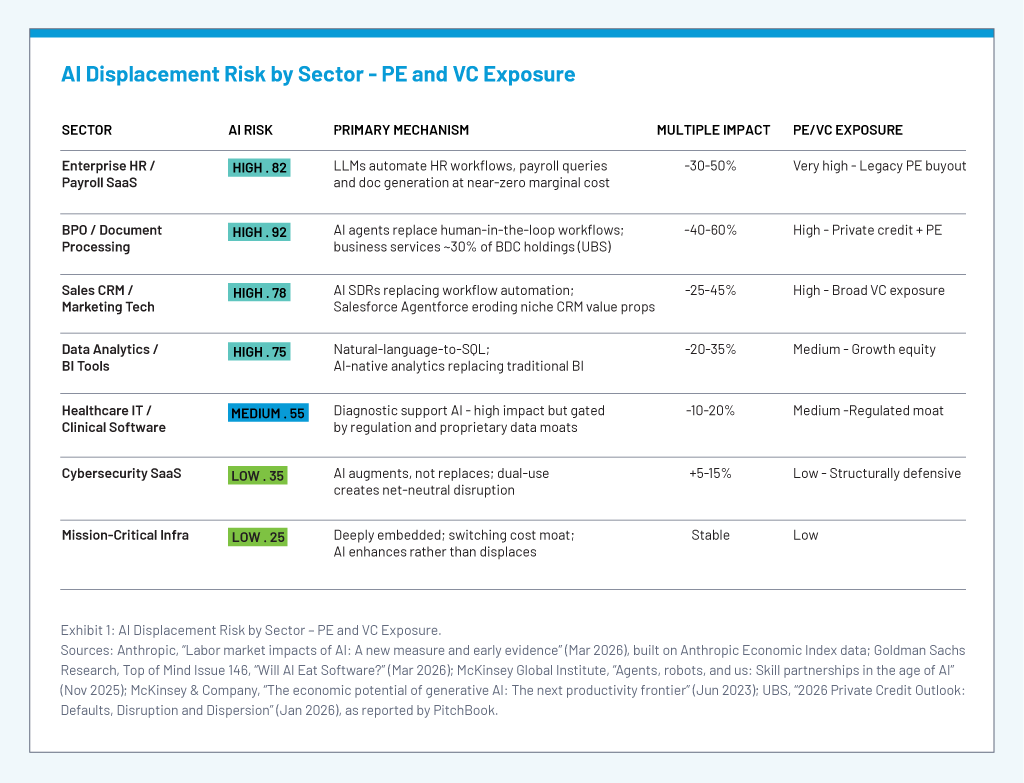
Public investors are increasingly distinguishing between software businesses that can use AI to strengthen their products and those whose revenue models may be exposed to AI-driven displacement. Seat-based SaaS, including HR workflow automation, business process outsourcing and sales CRM, may face pressure if AI reduces the number of users or changes how customers purchase software. A customer that deploys one AI agent in place of several software users may not renew the same number of seats. The effect may take several quarters to appear in GAAP revenue but could emerge earlier in net revenue retention, customer acquisition cost, renewal pricing, seat utilization and product usage.

Many general partners (GPs) may not yet know which side of this divide each holding falls on. Exhibit 1 provides a framework for assessing exposure to AI-driven displacement by sector. Managers that periodically reassess this exposure and identify the indicators most relevant to each holding may be better positioned to recognize changes in the investment thesis and valuation assumptions.

Building a More Forward-Looking Valuation Process

How Can Ongoing Monitoring Strengthen the Valuation Process?

A forward-looking valuation process supplements quarterly financial reporting with selected operating, market and competitive indicators that are relevant to each holding. The objective is not to replace a manager’s existing systems or valuation policy. It is to connect emerging evidence to investment decisions, valuation committee documentation and LP communication before deterioration becomes difficult to reverse. The value differs by stakeholder:

Why Historical Financial Reporting May Not Be Enough

Which Signals May Emerge Before the Financial Statements?

Quarterly financial statements remain foundational to the valuation process, but they may not surface changes in customer behavior or competitive positioning soon enough to inform forward-looking assumptions. A SaaS company whose net revenue retention declines from 112% to 101% may continue to report revenue growth for several quarters because subscription revenue is recognized over time. During that period, comparable-company multiples and buyer expectations may already have changed.

A more forward-looking process supplements GAAP reporting with three categories of evidence:

The Operator’s View

What Does AI Repricing Mean for Operating Partners?

Operating partners cannot determine the exit multiple a buyer will pay, but they can influence the earnings and strategic positioning to which that multiple is applied. Three practices can help operating partners respond.

Test Whether Operational Improvement Can Offset Multiple Compression

Because exit value is the product of EBITDA and the exit multiple, a 20% EBITDA improvement combined with 30% multiple compression produces enterprise value equal to 0.84 times entry value (1.20 × 0.70), even if the operating plan is delivered. If half of the purchase price was debt-financed, equity value would decline 32% before considering deleveraging. This analysis is most useful early in the hold period, when there may still be time to adjust the value-creation plan or reposition the business.

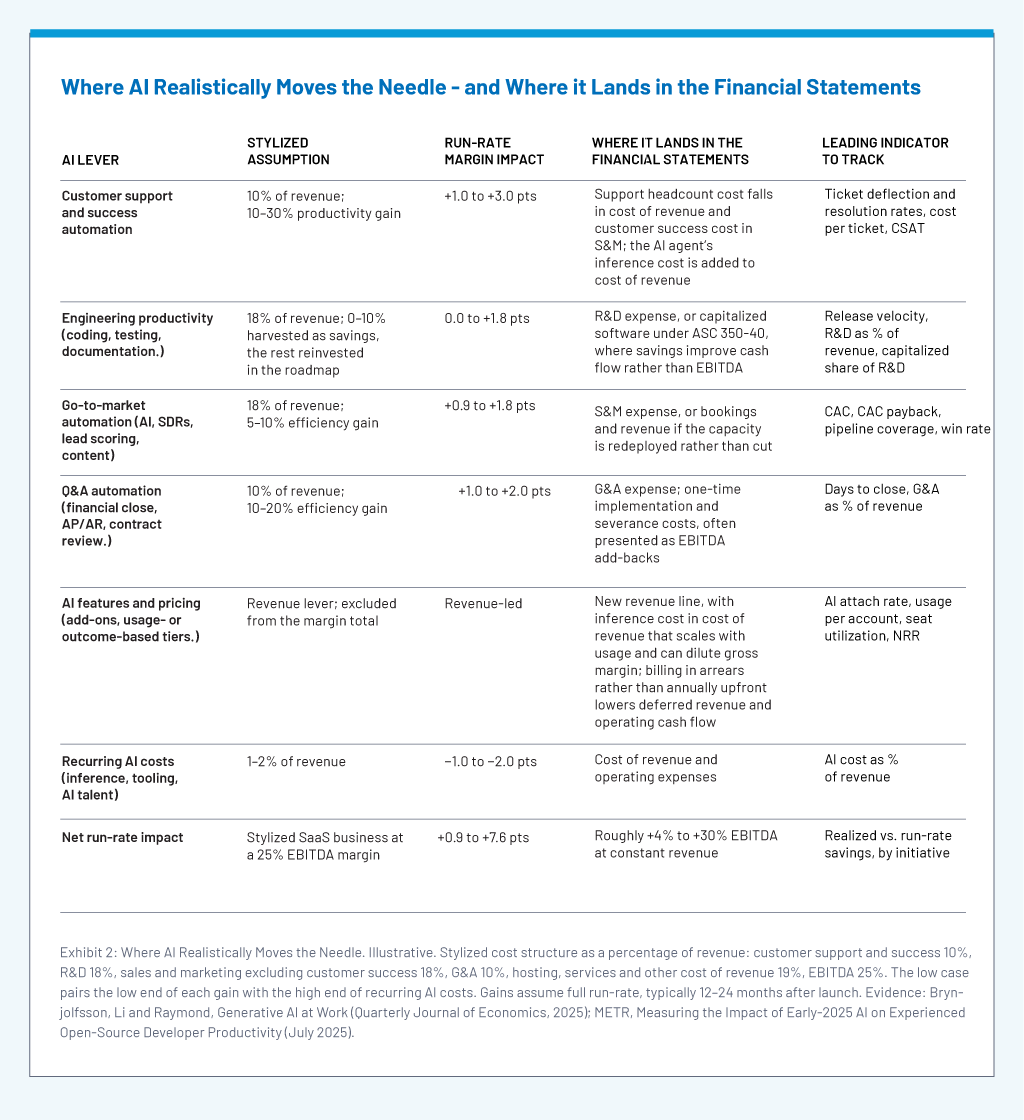
AI’s realistic contribution may initially be concentrated on the cost side and may be smaller than some value-creation narratives assume. For a stylized SaaS business at a 25% EBITDA margin, a successful program across customer support, engineering, go-to-market and general and administrative functions might add roughly 1 to 7.5 margin points at full run-rate, net of inference, tooling and AI talent costs. Evidence remains mixed, reinforcing the need to support company-specific assumptions rather than rely on broad productivity claims.

Offsetting 30% multiple compression at flat revenue would require a 25% EBITDA margin to increase to nearly 36%. Savings may take 12 to 24 months to ramp, competitors may compete away part of the benefit through pricing, and in seat-based models the same technology that lowers costs may also reduce the customer headcount on which revenue is based.

A larger lever may be the multiple itself. Moving a business toward the AI-application side of the divide by embedding AI into the product, shifting from seat-based to usage- or outcome-based pricing and building on proprietary workflow data may help limit compression. Buyers are likely to look for evidence of that shift in leading indicators, not only trailing EBITDA.

Track Leading Indicators, Not Just Lagging Ones

Operators often manage businesses using customer acquisition cost, net revenue retention, churn, pipeline coverage, seat utilization and product usage. Revenue, EBITDA and covenant headroom confirm what has already occurred. In subscription businesses, the lag is structural because revenue is recognized over time. By the time lagging metrics reflect deterioration, buyer expectations and fair-value assumptions may already have changed.

This connects directly to valuation governance. The indicators used to run the business can also provide evidence relevant to forecasts, comparable-company selection and scenario analysis. KPI definitions should be consistent across periods and, where practical, across holdings; net revenue retention alone can be calculated in several ways. Data should come from identified systems of record and be reconciled to financial reporting where relevant. These controls are prerequisites for reliable analysis, whether or not AI is used.

Model AI Initiatives Through the Financial Statements

Many AI value-creation plans begin as a narrative. A driver-based, integrated three-statement model can make each initiative explicit by identifying the volume driver, adoption curve, unit cost, implementation cost and financial-statement line items affected. This allows investors, lenders, auditors and buyers to assess the magnitude, timing and evidence supporting claimed benefits.

The model connects these practices by showing how much EBITDA an AI program must deliver, by when and under which exit-multiple assumptions. For GPs, the model may also support the valuation process. When an ASC 820 fair-value measurement relies on projected AI-driven margin expansion, those projections should reflect market participant assumptions and be supported by observable evidence where available. A traceable model can strengthen the valuation committee’s documentation; an unsupported margin bridge may create valuation risk.

Use Market Indicators as Valuation Triggers Between Quarters

A forward-looking process does not require fund managers to revalue portfolio companies continuously. Instead, selected external market indicators can serve as exception triggers for reassessing whether assumptions supporting the most recent valuation remain reasonable. A trigger does not automatically change fair value; it prompts the valuation team to determine whether forecasts, comparable-company selection, scenario assumptions, discount rates or selected valuation multiples should be reconsidered.

Public Comparable-Company Evidence

Monitor changes in enterprise value-to-revenue and enterprise value-to-EBITDA multiples, share-price performance, analyst estimate revisions and forward growth and margin expectations for a defined comparable-company set. Managers should also monitor dispersion within the group, including whether the market is differentiating between AI beneficiaries and companies facing AI-driven displacement. A material question is whether the portfolio company remains comparable to the same public companies used at the prior measurement date.

Transactions and Exit-Market Evidence

Track announced and completed M&A multiples, sponsor-to-sponsor transactions, strategic acquisitions, take-private activity, IPO conditions, exit volume and median holding periods in the relevant sector. This evidence can inform expected exit timing, the probability of an exit and the reasonableness of an assumed terminal or exit multiple.

Financing and Credit-Market Evidence

Monitor base rates, leveraged-loan and high-yield spreads, private-credit pricing, original issue discounts, leverage availability, interest coverage expectations and refinancing activity. Changes in financing conditions can affect buyer purchasing power, achievable transaction multiples, forecast interest expense and equity value.

Sector and Macro Indicators Tied to the Investment Thesis

Use indicators that have a demonstrable connection to the portfolio company rather than a generic macroeconomic dashboard. Examples may include information-technology spending and software employment for SaaS; purchasing managers’ indexes, backlog and capacity utilization for industrial businesses; procedure volumes, reimbursement and labor costs for healthcare; or retail sales, delinquency rates and consumer confidence for consumer businesses.

Potential Exception Triggers

Illustrative triggers may include the following. The appropriate thresholds should be tailored to the portfolio company, valuation methodology and fund valuation policy:

These thresholds are monitoring conventions, not accounting rules. Their purpose is to identify when observable market or company evidence has changed sufficiently to warrant additional analysis and documentation before the next scheduled valuation date.

Questions for the Valuation Committee

The private credit experience should be viewed as a warning signal rather than a direct roadmap for private equity. Closed-end PE funds have different liquidity structures, but the underlying valuation challenge remains: periodically reported values can lag changes in market evidence and portfolio-company fundamentals. For operating partners, a structurally lower exit multiple may require value-creation plans to be larger, earlier and more fully supported than before.

Fund managers that treat monitoring as an ongoing valuation and risk-management discipline, rather than only a quarterly reporting exercise, may be better positioned to explain why the investment thesis and fair-value conclusion remain supportable. This does not require a single proprietary technology platform. It requires clear ownership, consistent definitions, reliable source data, periodic reassessment of market evidence and documentation of how new information affects valuation judgments.

How Withum Can Help

As AI changes the competitive landscape for software and other technology-enabled businesses, fund managers may need to reassess whether existing valuation processes capture emerging risks on a timely basis. Withum’s Valuation Consulting Services Team can help private equity managers assess valuation policies and methodologies, evaluate market and operating indicators relevant to ASC 820 measurements, and consider how changing portfolio-company fundamentals and market conditions affect fair-value conclusions.

Withum plus signs.

Have Questions or Need Guidance?

For more information on this topic, please contact a member of our team.

Contact Us

Related Insights

Read more
Financial market chart with candlestick data, price trends, analytics and investment growth concept.
Energy Price Volatility, Margin Erosion and Hedging – Implementation Pitfalls for Commodity Hedgers

In the first quarter of 2026, Brent crude nearly doubled, from $61 to $118 a barrel, its largest inflation-adjusted quarterly increase in data going back to 1988. For an unhedged company, a move like that goes straight to the margin. Take a manufacturer with $40 million in revenue, cost of goods sold at 60% of…


Read more
Hand writing on paperwork with holographic market charts rising above, reflecting financial analysis, risk management, and results oriented planning.
Private Company Roadmap to Hedging FX, Interest Rate and Commodity Risks

Interest rate swaps, FX forwards, and commodity hedges are increasingly common among mid-market companies – yet the resources, systems, and technical expertise needed to maintain full ASC 815 compliance are often limited. For eligible private companies, ASC 815 Private Company Alternative offers a simplified hedge accounting approach for certain hedging instruments. In practice, private companies…

Read more
glowing car with a question mark above
Dealership Valuation FAQs: 10 Questions Every Dealer Should Ask

Dealerships can be valued using several approaches, including the income, market and asset approaches. Within each approach, various methods and assumptions may be considered. A dealership valuation typically includes tangible assets such as cash, inventory and equipment, as well as goodwill, more commonly known as “blue sky” associated with the dealership. This FAQ explores the…