

Any suggestions and illustrations in this blog are not intended as financial advice. They are my personal opinions.
Anyone investing is told to diversify their portfolio, and they are provided with some broad categories that could be used. I also believe in diversification. However, by consulting with many clients during my long career, I have learned that diversification either doesn’t work for a lot of people or is the wrong focus.
Whatever you invest in carries a risk. Stocks can go down, but so can bonds, and inflation can go up, eroding spending power. Doing nothing also presents a risk if inflation goes up more than expected. Diversification is a method of balancing risk and allowing you to assume the proper level of risk for you. “For you” is the important part of that last sentence. Each person has different needs, goals, purposes, desires and feelings about risk. What each person needs to do for themselves is to determine how they should invest to accomplish what they are trying to accomplish with their investments. Scripted maneuvers and sage advice about how to invest are excellent as teaching tools to introduce inexperienced investors to the available methods they should consider, but not necessarily follow blindly.
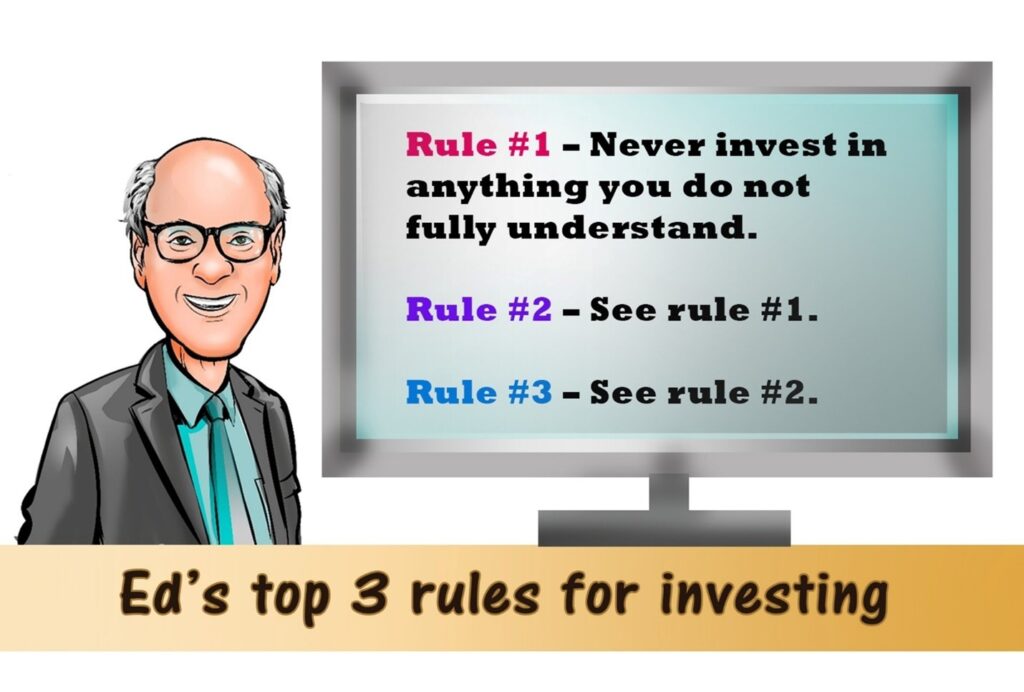
Before I continue, I want to repeat my three rules for investing:
In this posting, I want to discuss the “validity” of diversification. The purpose of diversification is to provide a mix of investments that offset each other during conflicting times. Stories about diversifying assets appear in the Bible (Genesis 32:7-8), in Cervantes’ Don Quixote (1605) with the adage “Don’t put all your eggs in one basket,” and on the FINRA website. Further, Harry Markowitz won the 1990 Nobel Prize for his work on portfolio diversification. As a CPA and financial planner, I’ve advised many clients of all ilk on spreading their risk.
I do not want to denigrate asset diversification, which is very important, but I believe I have two more important approaches to investing that I would like to suggest. Instead of focusing on assets, focus on attaining cash flow targets. For many people, the primary purpose of investing should not be to acquire the most assets, but to secure their eventual cash flow for when they are no longer earning an income. Having a large portfolio with little cash flow will not provide that security. It might make them feel good, but it’s the cash flow that they will be living on. Secondly, no one should ever invest in anything where they do not fully understand how they could make or lose on that investment. Maybe a third approach should be that they need to understand the various types of risk they are subjected to when they decide to invest.
Diversifying assets into parts is admirable and seemingly protective for at least part of your assets. But if cash flow is your goal, I suggest that your investment strategy should be to obtain, or to try to attain, the desired amount of cash flow. Investing to protect part of your assets might succeed, but how successful would that be if you failed on your cash flow targets? I believe the primary portfolio strategy should be to reach that cash flow target. Once that is in sight, then the strategy could shift to protect that amount and also try to further grow your portfolio.
Keep in mind that we are dealing with long-term periods of perhaps 10 or more years. At some point, the momentum will be established, and you will be able to determine whether you will reach your cash flow target. Also, we are dealing with a lot of moving parts, such as interest, dividends, inflation, tax rates, the overall economy, how much disposable income you have from your employment, the amount of investment income that is able to be reinvested, your spending amounts, some of it discretionary, and what you might need when you retire. You also have a decision to make on when to retire, start collecting Social Security and your pension (if you have one) and how you want the pension payout to your spouse to continue upon your death. None of these are easy questions, and a lot is totally out of your control.
While I hate to proclaim some rules to follow (other than my top three rules of investing), here are some steps that need to be considered:
- Credit card debt is a sin of overspending and should be reduced as quickly as possible. All purchases that you charge that cannot be paid in full the day you receive your bill should be stopped, as well as all unnecessary purchases.
- If you have a mortgage and if that rate is greater than what you would earn on your investments (depending upon your investment strategy), then consider accelerating the repayment by adding something to each month’s mortgage payment. Whatever you add will have you “earn” your mortgage interest amount on that payment. Note that the credit card debt should be liquidated before making these additional payments.
- Curtail all discretionary purchases and use that cash to add to your investible assets until you know you will reach your cash flow targets.
- Prepare a listing of your investable assets, including all of your retirement accounts, and allocate them into fixed income, stock market and other categories and the annual cash flow from each category. Project that out five or 10 years and see where it gets you. Use that as your starting point.
- I do not know what your “other categories” might be, so I will not offer any suggestions for that other than to ask you to determine their potential growth and liquidity should you need to sell them to raise cash to live on.
- Before you proceed, set aside your rainy day funds.
- Your fixed income can be invested in bank certificates of deposit, U.S. Treasury securities, corporate bonds or similar investments. The length of the terms of these investments would vary based on your target. However, none of this would be needed for immediate spending, so it is not necessary to keep these completely available in money market accounts. Be aware that when you make a decision to invest either short or long term, you are “gambling” on what the future rates will be. I think it's best to make your decisions on today’s choices and deal with the future choices as they arise. You will be investing on a regular basis from today until you feel your goals will be met, and then you should change your cash flow attainment strategy. Note that I do not recommend bond funds since they are subject to huge fluctuations in value.
- Investing in the stock market (i.e., equities) provides many decisions you have to make. Large or small cap. Value or growth. High dividend preferred or lower dividend common. Domestic or foreign. Passive or active funds. And many other gradations. When you start implementing your plan, I suggest that the concentration of your investments be on the fixed income, which would bring you closer to your cash flow goals. I would not abandon equities completely and would suggest an allocation of up to 25% of your investible funds, so you have the potential for portfolio growth that fixed income doesn’t offer. Also, while you might start out with a greater amount earning higher interest rates, interest that is reinvested could be in equities that would gradually increase your portfolio percentage in the stock market. You need to work out these numbers. But start with your cash flow needs.
- Your present spending includes a certain amount of discretionary items. If you feel you might not attain your cash flow goal at your desired date, then you can either consider reducing some of your current spending, lengthen your retirement date or include some eventual part-time employment income in your plan.
- When you attain your cash flow target, things should not abruptly stop. There should be a gradual change in your investing strategy. At some point, the shift should be to how you can assure that you (and your spouse, if married) will not outlive your cash flow and money supply, and not the other way around.
This is an important subject and can affect the degree of financial security you will have and feel for the rest of your life. Take the time and make the effort to do it right.
Takeaways
A takeaway is to invest for cash flow, not asset appreciation; do not obsess over asset diversification, which does not focus on cash flow, but instead on balancing portfolio ups and downs; and make sure you fully understand everything you invest in.
I could write a lot more…and have. You can search my Partners’ Network blog archive and find dozens of my financial planning postings. If you want my 100-page February 2025 stock market speech handout emailed to you, request it at [email protected] and just put “Stock Market Handout” as the subject. No messages necessary.
Enjoy the Holidays and Have a Happy New Year.
Contact Me
If you have any tax, business, financial or leadership or management issues you want to discuss please do not hesitate to contact me.