

Articles
6 min read
What to Expect During Your First 90 Days with Outsourced Accounting
Why Companies Start Looking in the First Place
Most organizations don’t wake up one day and decide to outsource their accounting function on a whim. There’s usually a trigger. Often a series of them.
The monthly close is inconsistent or drags on for weeks. Key accounting roles turn over, leaving gaps no one has time to fill. Leadership lacks confidence in the numbers, or worse, avoids relying on them altogether. Finance leaders find themselves buried in transactions instead of focusing on strategy. And in many cases, the same question keeps coming up: Why does something this critical feel so fragile?
If you’re considering outsourced accounting services, understanding what happens during implementation and the first 90 days can help set realistic expectations and prepare your team for a smoother transition.
If these sound familiar, you’re not alone; they’re the classic signs it’s time to explore outsourced accounting. What’s discussed less often is what happens next. When companies consider the move, the questions are as pressing as the problems:
- Is this going to be a nightmare to implement?
- How much work is this going to create for me in the short term?
- Will this actually fix anything, or just introduce new issues?
Those are the right questions to ask.
So let’s set expectations clearly. Here’s what the first 90 days with an outsourced accounting team typically look like, what we take on, what you should expect to stay involved in and how things tend to evolve.
What Does Outsourced Accounting Actually Mean Day-to-Day
Outsourcing accounting doesn’t mean flipping a switch and walking away from the function overnight. In practice, it’s far more measured and collaborative.
At the day-to-day level, outsourcing usually involves transferring responsibility for core accounting activities such as:
- Transaction processing
- Account reconciliations
- Month-end close coordination
- Financial reporting
What changes is who is driving those processes. What doesn’t change is the importance of your business context, your judgment and your visibility into the outcomes.
A well-structured outsourced relationship should feel like continuity, not disruption. Your team doesn’t disappear; it evolves. Internal stakeholders still interact with familiar processes, invoices still need approval, expenses still require review and operational input still matters.
The difference is that instead of reacting to issues or chasing incomplete work, you’re collaborating with a team that owns the execution and brings structure to it.
In other words, the day-to-day becomes more organized, more predictable and less dependent on any one individual.
How Things Typically Evolve Over the First 90 Days
No two onboarding experiences are identical. The starting point, system maturity, documentation and team structure vary widely. That said, there are common patterns most organizations experience in the first 90 days.
Early Phase: Understanding and Stabilization
The first several weeks focus on understanding your current state, not forcing immediate change.
This includes reviewing processes, mapping workflows, assessing the quality of existing data and identifying key risks. Inevitably, inconsistencies or backlogs come to light. That’s normal. It’s also where the work begins.
Middle Phase: Cleanup and Consistency
Once the environment is understood, the work shifts toward cleanup and stabilization.
This could involve:
- Catching up on delayed reconciliations
- Standardizing close procedures
- Addressing prior-period discrepancies
- Establishing clear documentation
You begin to see early improvements in cadence, fewer surprises, clearer timelines and a more structured close process.
Later Phase: Visibility and Confidence
By the end of the first 90 days, most organizations start to experience what they were hoping for in the first place: better visibility.
Financial reporting becomes timely and consistent. Leadership gains greater confidence in the numbers.
It’s important to emphasize: this progression is not rigid. Some organizations move faster, some require more time in certain areas. The approach is intentionally flexible, designed to meet you where you are, not force you into a predefined model.
Who Owns the Execution Work: The First 90 Days
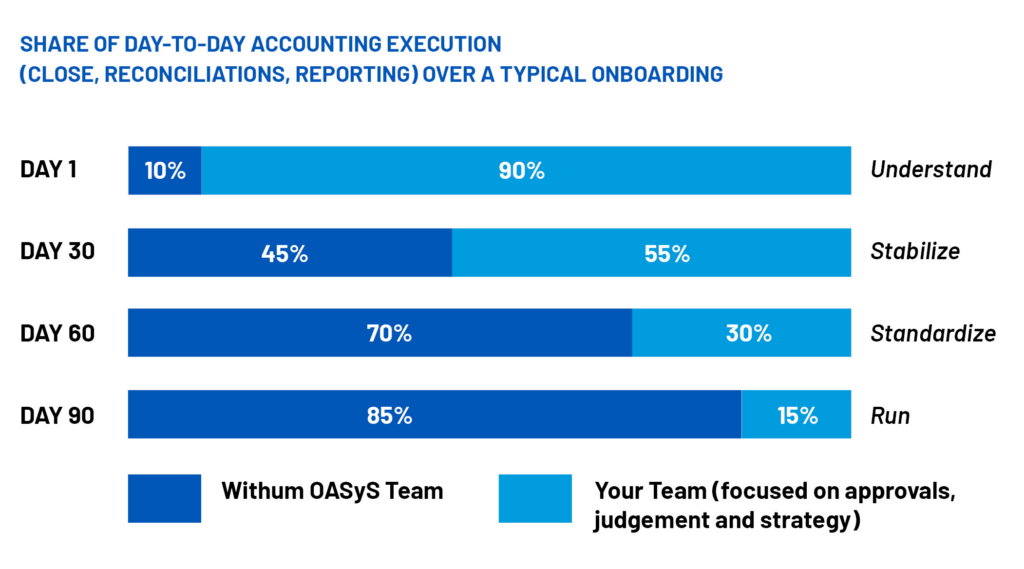
Illustrative of a typical engagement; pace varies by system maturity, documentation and team structure.
Early Touchpoints and Shared Responsibilities
One of the biggest misconceptions about outsourcing is that it’s a “black box.” In reality, the early stages are highly interactive.
What the Outsourced Team Takes On
From the outset, the outsourced team begins absorbing responsibility for execution-heavy tasks, including:
- Managing the close process
- Preparing reconciliations
- Producing draft financials
- Maintaining accounting records
This is where you start to feel immediate relief. The daily burden of “getting it all done” begins to shift.
Where Your Input Is Still Critical
At the same time, your involvement remains essential in key areas:
- Providing access to systems and historical data
- Clarifying business practices and judgment calls
- Approving transactions and outputs
- Staying engaged in regular check-ins
Your institutional knowledge and decision-making authority don’t go away, they become more focused.
What Typically Stays with You
Certain responsibilities often remain internal, depending on your structure:
- Strategic financial decisions
- Budgeting and forecasting ownership
- Final approvals and governance
The goal isn’t to replace leadership; it’s to support it with stronger execution and better information.
At its core, outsourcing works best when it’s approached as a partnership, not a handoff.
What “Better” Actually Looks Like
It’s fair to ask whether all of this effort leads to meaningful improvement.
One of the earliest signs of progress is a more predictable financial close. For example, companies that were previously closing their books three to four weeks after month-end, often with ongoing adjustments, are moving to a much tighter, more predictable close timeline.
That doesn’t happen overnight. It happens because:
- Processes are documented and consistently followed
- Accountability is clearly defined
- Work is performed by a team designed for continuity, not dependency
The result isn’t just speed. It’s reliability.
And with that reliability comes something more valuable: leadership spends less time questioning the numbers and more time using them to make informed business decisions.
Whether you’re looking to replace an internal accounting function or augment your existing finance team, understanding what to expect during the first 90 days can help set realistic expectations before making the move.
If you still have questions about getting started, onboarding timelines or software compatibility, our Outsourced Accounting FAQ covers what most organizations want to know before making the switch.
Ready To See What Your First 90 Days Could Look Like?
Withum’s Outsourced Accounting Systems and Services (OASyS) Team manages this transition every day, bringing structure where there was inconsistency, clarity where there was uncertainty and progress where things felt stuck.

Have Questions or Need Guidance?
Learn how outsourced accounting services could work for your organization.
Contact our OASyS Team to discuss your current accounting processes and what a transition could look like.
Related Insights

From Reconciliation to Better Tax Reporting – A Process as Good as Gold
This final article in the series brings together the key elements of the return-to-provision (RTP) process. The first article examined why RTP matters, and the second outlined the core reconciliation process. This final article focuses on establishing a gold-standard RTP process by connecting reconciliation findings to current tax payable, deferred tax balances and future process…

Building a Defensible Return-to-Provision Reconciliation
This article is a continuation of our previous article which discusses the importance of the return to provision process. This article digs a little further into the specifics of the return to provision process to outline some key items to be considered. A useful Return-to-Provision (“RTP”) analysis begins with discipline at the starting point. Before…