Articles 5 min read

How AI Is Resetting the SaaS Valuation Multiples in Private Equity and Private Credit

Key Takeaways

AI is disrupting the software business models that have historically justified the premium valuation multiples underpinning many private equity and private credit investments.

As AI reshapes cost structures, product differentiation, pricing power and growth expectations, investors are increasingly reevaluating the assumptions that have long supported elevated software valuations.

AI-driven disruption is increasing the need for more robust portfolio valuations, portfolio monitoring and valuation governance, making an audit-defensible roadmap essential for integrating AI-related risks into ASC 820 fair value analyses.

The private credit redemption wave of 2025–2026 has renewed focus on how software and technology assets are valued in an evolving AI environment. Software remains a significant area of concentration across alternative investment portfolios.

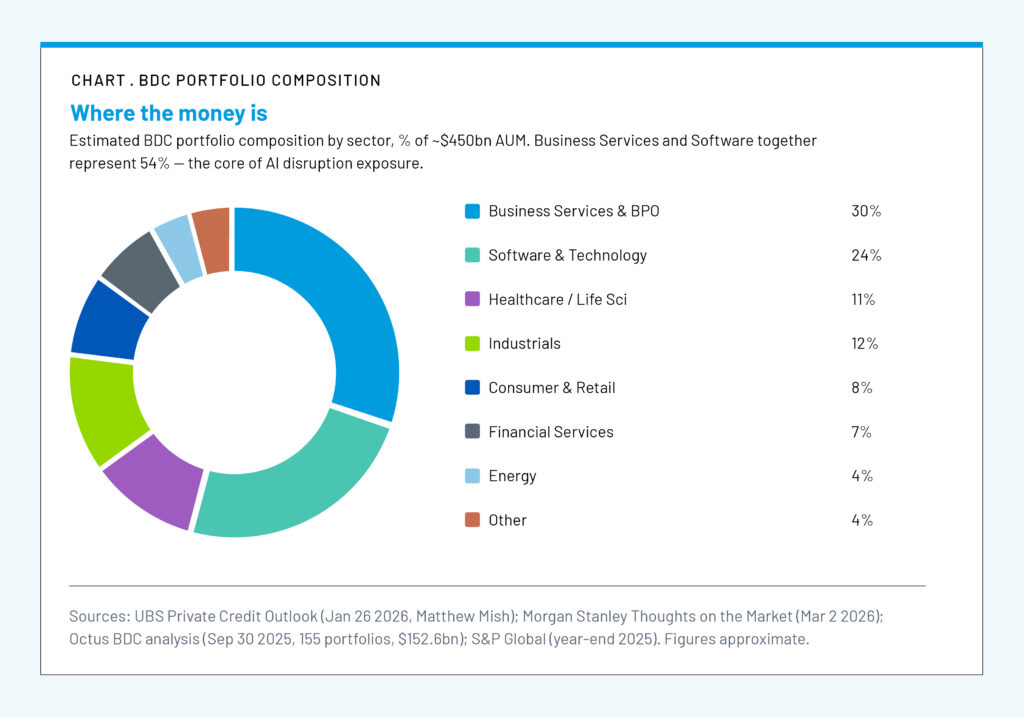
A quarter of private credit – approximately $112 billion – is in software and technology. On the equity side, software drew approximately $203 billion, or roughly 18% of all U.S. private-equity deal value in 2025, the highest concentration on record. Many of those investments are still marked near par. Whether the businesses behind them are still worth par is exactly the question AI disruption raises. The potential gap between what private credit portfolios are marked at and what the underlying software assets are actually worth, given AI disruption, represents an important risk management question for alternative asset managers in 2026.

The redemption wave that rattled private credit had an immediate cause: liquidity. But behind it lies a slower, deeper reckoning about what the underlying assets are actually worth – and whether the business models that justified the original underwriting still exist.

Some market participants have labeled the resulting pressure on software valuations the “SaaSpocalypse.” This reflects growing concerns about how AI may be impacting portions of the software industry. Anthropic’s February 2026 tool release was one catalyst for a sharp selloff in software data provider shares and refocused investor attention on a vulnerability building for months: the sector-wide redemption pressure that swept private credit portfolios, which had enthusiastically lent against software’s recurring revenue and high margins, has exposed questions about whether those characteristics remain durable in an AI-driven environment.

The Scale of Exposure

How much private credit is exposed to AI-disrupted software?

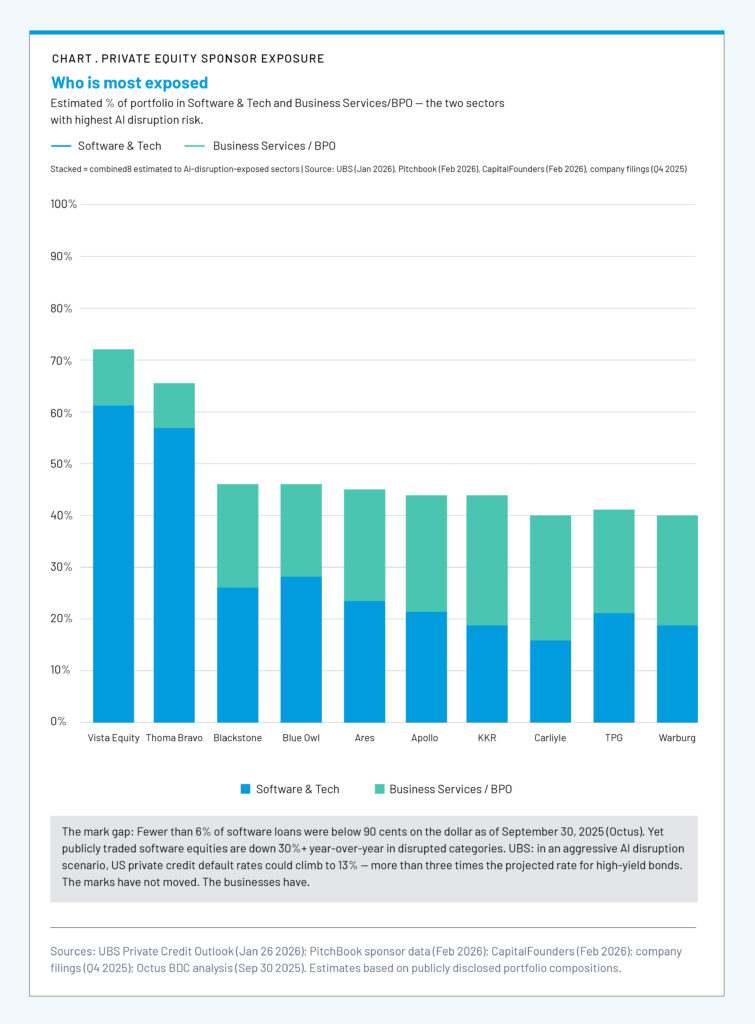
Software and technology account for a significant portion of many private credit portfolios. Octus, analyzing 155 public and private BDC portfolios representing $152.6 billion of debt principal, found software exposure at approximately 29% as of September 30, 2025. Critically, fewer than 6% of software loans were marked below 90 cents on the dollar as of that date. These marks have remained relatively stable despite significant valuation changes in portions of the public software market.

The Disruption Mechanics

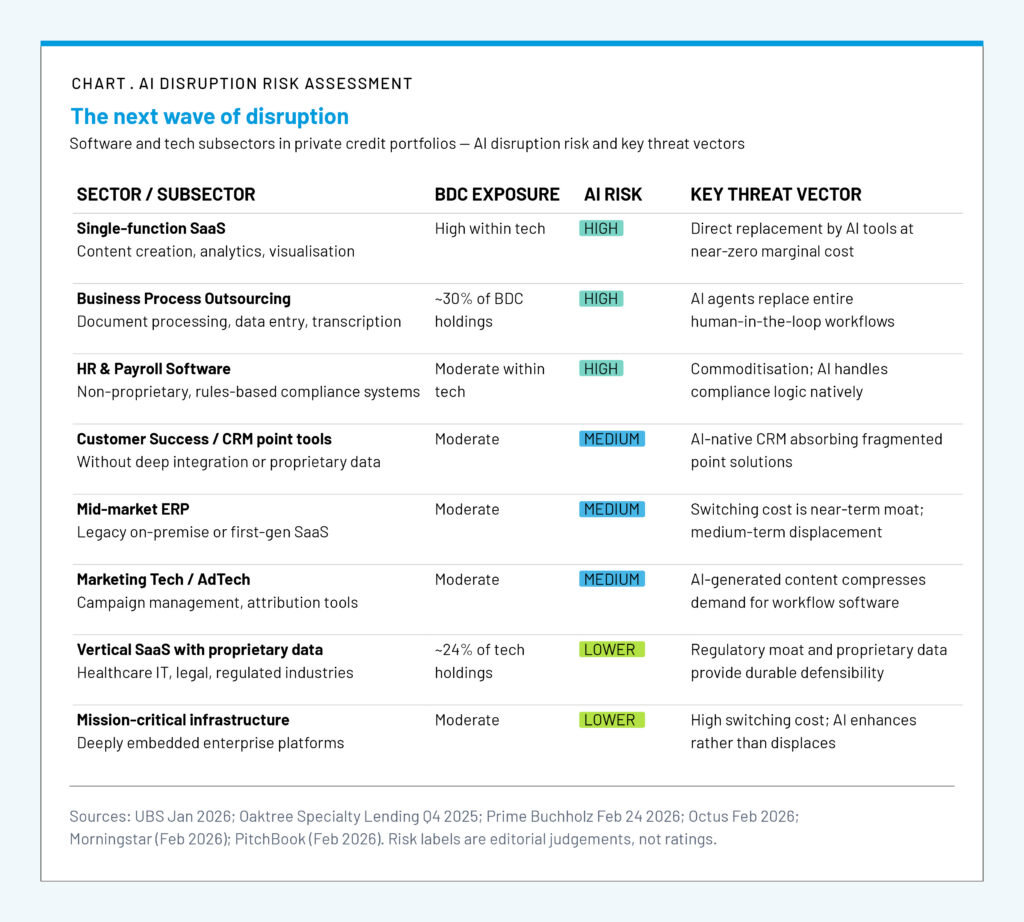
Private credit favored software businesses for several characteristics, including strong margins, recurring revenue models and asset-light operating structures that supported leverage. These justified aggressive unitranche loans with elevated leverage and limited covenants through the 2020–2022 boom. AI is not affecting all software companies equally. Instead, it is prompting investors to reevaluate many of the characteristics that historically made software attractive to private credit lenders.

Oaktree Specialty Lending highlighted a key concern: the primary risk is not immediate credit deterioration but refinanceability at maturity. Although many of these loans continue to perform, questions remain about their ability to refinance at maturity.

The credit quality discussion is also shaped by vintage. Many software businesses were acquired during the 2020-2021 buyout cycle, when software valuations were elevated, and private credit financing was widely available. Those investments were often underwritten based on expectations of continued growth, strong margins and durable recurring revenue. As AI reshapes competitive conditions across parts of the software sector, fund managers may need to revisit those assumptions when evaluating borrower performance, refinancing prospects and valuation estimates.

PE Sponsor Exposure

Software loans in BDC portfolios were often created by PE sponsors who acquired software businesses during the 2020–2022 valuation cycle and financed them with private credit. Vista Equity Partners and Thoma Bravo, as software-focused buyout firms, have significant exposure to the sector. While the extent of AI disruption may vary by company and subsector, investors continue to assess how evolving competitive dynamics could affect software valuations, operating performance and refinancing prospects.

A broader consideration is the generalist sponsors who accumulated software exposure at elevated valuations and now hold those investments in PE funds facing slower distributions and private credit portfolios marked near par.

The Mark Problem

The near-term picture is more reassuring: according to Octus, fewer than 10% of software loans mature before 2028, limiting immediate default pressure. The most embedded vertical SaaS – healthcare IT, legal, regulated industries – retains defensibility through regulatory moats and proprietary data.

The evidence suggests the mark problem may be more structural than cyclical. Private credit marks lag observable signals by design – the asset class has no daily price discovery. But differences between portfolio marks and signals from public markets may create governance and valuation considerations: under ASC 820 and the SEC’s 2025 examination priorities, fund advisers are required to update fair value estimates when “significant changes” occur. AI disruption at scale – with publicly observable revenue impact on comparable public companies – creates a need for fund managers to consider whether those developments affect valuation assumptions and related governance processes.

Three Practices 

Not all software is equally exposed to AI-related disruption. Single-function SaaS and BPO may face higher theoretical AI exposure. Vertical SaaS with proprietary data and regulatory barriers retains substantial defensibility. LP-level disclosure and valuation reviews may benefit from distinguishing between these at the borrower level, not the asset-class level. Any assessment framework should be grounded in data rather than assumptions, including the Anthropic Economic Index, Goldman Sachs AI sector research and observable revenue impact from public comparable companies.

Portfolio-level statements about diversification may not fully address ASC 820 measurement-date requirements. The mark on each credit should be defensible on its own terms, answering the following questions:

For the most at-risk subsectors, DCF mechanics alone may not fully capture business model durability. Additional qualitative analysis, including input from external valuation specialists with AI and software industry knowledge, may help supplement traditional valuation approaches when assessing long-term business viability.

Disclosing discount rates and key valuation assumptions for software holdings may provide investors with granular visibility into this concentrated exposure. If AI-driven revenue deterioration is identified in more than a defined threshold of software borrowers, independent valuation support may help strengthen governance processes and support ongoing portfolio oversight.

Final Thoughts

AI-related disruption is unlikely to arrive all at once. It will emerge borrower by borrower, renewal cycle by renewal cycle and maturity by maturity. The funds that will navigate it are not necessarily the ones with the least software exposure. They are the ones with the valuation discipline to distinguish the defensible from the disrupted.

Withum plus signs.

Have Questions or Need Guidance?

If your fund holds software or technology loans and you have questions about ASC 820 compliance, borrower-level AI disruption scoring or independent portfolio review, Withum can help.

Contact Us

Related Insights

Read more
Person touching smart watch displaying heart rate and health icons wrist finger
How To Choose the Right Valuation Framework in Digital Health

For digital health businesses, enterprise value is rarely explained by earnings alone. While EBITDA remains a useful indicator of operating performance, it does not fully capture durability, transferability, or risk‑adjusted sustainability. This gap exists because intangible assets create value in fundamentally different ways. Some drive economic performance directly, while others enable, protect, or condition it….

Read more
Hands holding toy car on cash stack. Auto loan concept with percentage discount rates.
COVID-19’s Ongoing Impact on Franchise Auto Dealership Valuations

Franchise auto dealerships experienced an unusual period of profitability between 2020 and 2023, driven by supply constraints, shifting consumer demand and changing market dynamics. While many operating metrics have since moved closer to historical norms, the industry’s pandemic-era performance continues to influence how dealerships are valued today. The unusually strong earnings generated during that period…

Read more
business continuity
Guide: Business Continuity and Disaster Recovery – Strategic Insights for Operational Resilience