Life Sciences Valuations in Tight Capital Markets: When Uncertainty Creates Value
In today’s constrained capital markets, uncertainty has become a primary driver of value in the global life sciences sector. Biotechnology, pharmaceutical, and medical device companies, particularly those operating in innovation hubs such as the United States, Europe, and Asia-Pacific, are increasingly valued on future milestones rather than historical performance. Shifting capital dynamics are reshaping business valuation expectations and risk‑adaptive valuation frameworks designed for early‑stage and growth‑stage life sciences companies.
Understanding Uncertainty Becomes a Valuation Strategy Necessity
Uncertainty is the primary force that determines business value across the biotechnology, pharmaceutical and medical device industries. Unlike sectors where valuation is anchored in historical revenue or predictable operating performance, life sciences companies are valued largely on what has yet to occur. Scientific hypotheses, clinical trial results, regulatory decisions, and commercial adoption all lie in the future. This inherently forward‑looking risk profile directly shapes how capital is evaluated and deployed across the sector.
As capital providers become more selective and diligence standards rise, valuation models that fail to reflect how risk changes over time are increasingly misaligned with market expectations. In response to this uncertainty, this shift in the industry toward cautious and milestone‑driven capital deployment has increased the use of SAFE (Simple Agreements for Future Equity) instruments and convertible notes. These SAFE instruments and convertible notes offer flexible, fast funding while deferring dilution amid uncertainty. These structures balance founders’ need for capital efficiency with investors’ desire for downside protection and future upside. Understanding uncertainty is no longer just an analytical exercise, it is a strategic necessity.
A Shifting Capital Environment Raises the Stakes
The funding landscape for life sciences and pharmaceutical biotech companies has entered a more disciplined phase. While long‑term confidence in innovation remains intact, near‑term capital allocation has tightened, driven in part by the steadily increasing cost and duration of taking a drug to market. Fewer deals are being completed, investment committees are applying higher bars, and public sector support for early research has become less predictable.
Proposed FY2026 National Institutes of Health (“NIH”) funding cuts have increased uncertainty in the life sciences sector, disrupting funding trends and potentially harming long-term innovation and investment. The FY2026 budget proposal sought to cut NIH funding by about $18.0 billion (~40.0%), reducing it from roughly $46.0 to 47.0 billion in FY2025 to $27.0 to 29.0 billion.
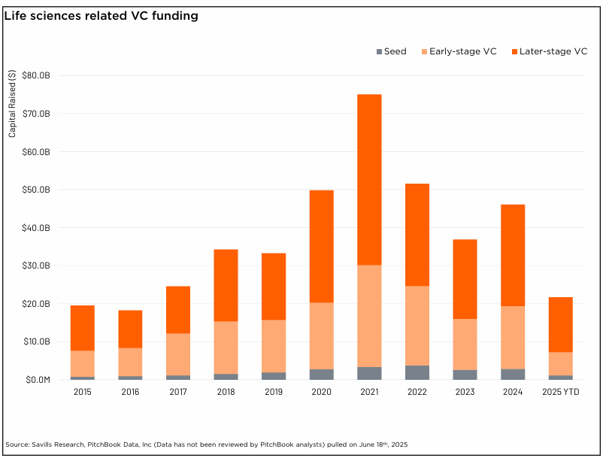
Life sciences VC funding remains strong despite increased investor selectivity. In 2025 YTD, funding reached $20.8 billion, following a 24.9% increase in 2024 even as deal volume declined. Investment is concentrated in early-stage platforms (pre accelerators and incubators) and later-stage, lower-risk companies with proven or near-term revenue models.
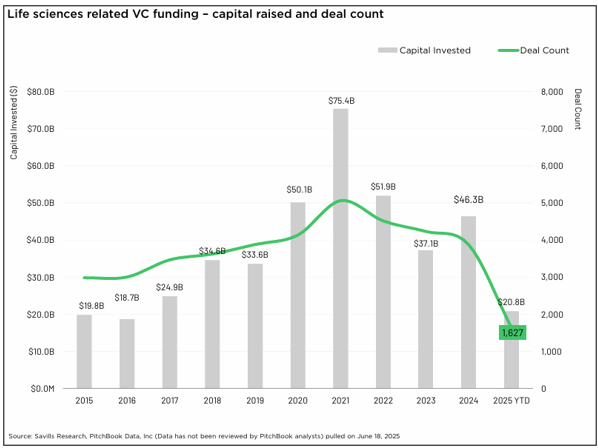
Drug discovery continues to attract the largest share of capital, driven by growing use of AI to improve R&D efficiency and therapeutic development.
In this environment, valuation errors carry real consequences. Inflated expectations can derail fundraising or delay strategic transactions. Conservative pricing, on the other hand, may lead to avoidable dilution or constrain growth options. Given the extended timelines and high failure rates inherent to product development, both management teams and investors need valuation approaches that evolve alongside an asset’s risk profile. However, in practice, prevailing valuation methodologies often fall short of fully addressing this requirement.
A New Capital Paradigm and Its Impact on Life Sciences Valuation
Many valuation frameworks attempt to address uncertainty by embedding it into a single discount rate applied across all future cash flows. While convenient, this approach assumes that the level of risk remains constant from early research through commercialization, an assumption that rarely holds true in practice.
This simplification can lead to distorted outcomes. Early stage programs may appear prohibitively risky, while late stage assets may seem more stable than warranted. As programs advance and assumptions change, valuations often need to be revisited entirely, creating confusion and misalignment among stakeholders.
A more nuanced approach is required, one that separates the passage of time from the resolution of uncertainty.
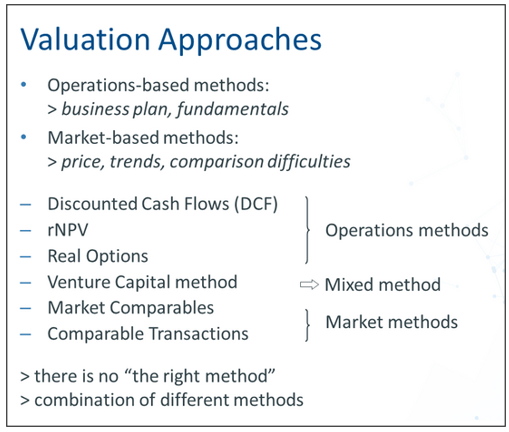
Valuation methods fall into two main categories: operations-based and market-based approaches.
- Operations-based methods estimate intrinsic value by analyzing a company’s fundamentals, business plan, and projected cash flows. Examples include DCF, rNPV, and Real Options, which incorporate risk and managerial flexibility but may underrepresent market conditions.
- Market-based methods determine value using external benchmarks, such as Market Comparables and Comparable Transactions, relying on pricing data from similar companies or deals. These approaches reflect market sentiment but can be limited by volatility and a lack of suitable comparables.
- A mixed approach, such as the Venture Capital method, combines elements of both and is often applied to early-stage ventures where uncertainty is high.
No single method is sufficient on its own, particularly in life sciences. In practice, combining multiple valuation techniques provides a more balanced and reliable assessment of value.
Practical Implications for Decision Makers
For life sciences leadership teams, a risk adjusted framework supports more informed choices across the organization. It helps management:
- Pinpoint the milestones that drive the greatest value inflection
- Allocate capital across programs with competing risk return profiles
- Assess partnering, licensing, and acquisition opportunities on a comparable basis
- Early-stage tax planning for the founders
- Communicate progress to boards and investors with greater credibility
For capital providers, consistent application of risk aware valuation methodologies offers a window into management’s strategic discipline and capital stewardship.
The Withum Perspective: From Managing Risk to Leveraging It
Uncertainty cannot be eliminated from life sciences development, but it can be modeled, monitored, and managed. Organizations that align valuation practices with the realities of development are better equipped to navigate volatile markets, engage the right partners, and sustain long term innovation. Withum partners with life sciences companies and investors to employ valuation frameworks that reflect how risk truly unfolds over time. By moving beyond static assumptions and toward milestone driven analysis, our teams help clients support strategic planning, capital formation, and value realization, transforming uncertainty into actionable insight at every stage of growth.
Move beyond static assumptions. Engage Withum to implement milestone‑driven valuation approaches that support strategic planning, partnering, and capital formation.
Authors: Uday Singh | [email protected] and Gaurav Kumar | [email protected]